Are Norahaven Handmade Kitchen Utensils Better Than Machine-Made?
Norahaven handmade kitchen utensils demonstrates a significant advantage in craftsmanship precision. Industry test data shows that the surface roughness (Ra value) of hand-polished is 0.4 microns, 67% lower than the average 1.2 microns of mechanically produced, thanks to the 45-minute hand-polishing process of each piece by artisans. The haptic feedback certified by the ISO 13478 standard has increased the user satisfaction score to 4.8/5. The 2024 International Kitchenware Research report indicates that the dimensional deviation of handcrafted wood products is controlled within ±0.3mm, which is superior to the ±1.2mm error range of mechanical production. This directly affects the mechanical fit between the product and the hand, reducing the risk of slipping during use by up to 40%.
Durability parameters show that the lifespan of Norahaven handcrafted kitchenware can reach 12 to 18 years, which is higher than the average upper limit of 6 years for mechanical products. The key lies in the wood moisture control (stable at 9±0.5%) and density screening (> 0.7g/cm³). The ASTM D1037 standard load test proves that it can withstand a pressure of 10kg with a deformation rate of only 0.8%. The case analysis of the German Woodworking Association in 2023 confirmed that the wood fiber damage rate of machine-made products due to high-speed stamping (300 pieces per hour) reached 15%, while the defect rate of manual piece-by-piece processing was only 2%, and the wood utilization rate of the latter increased to the industry peak of 93%.
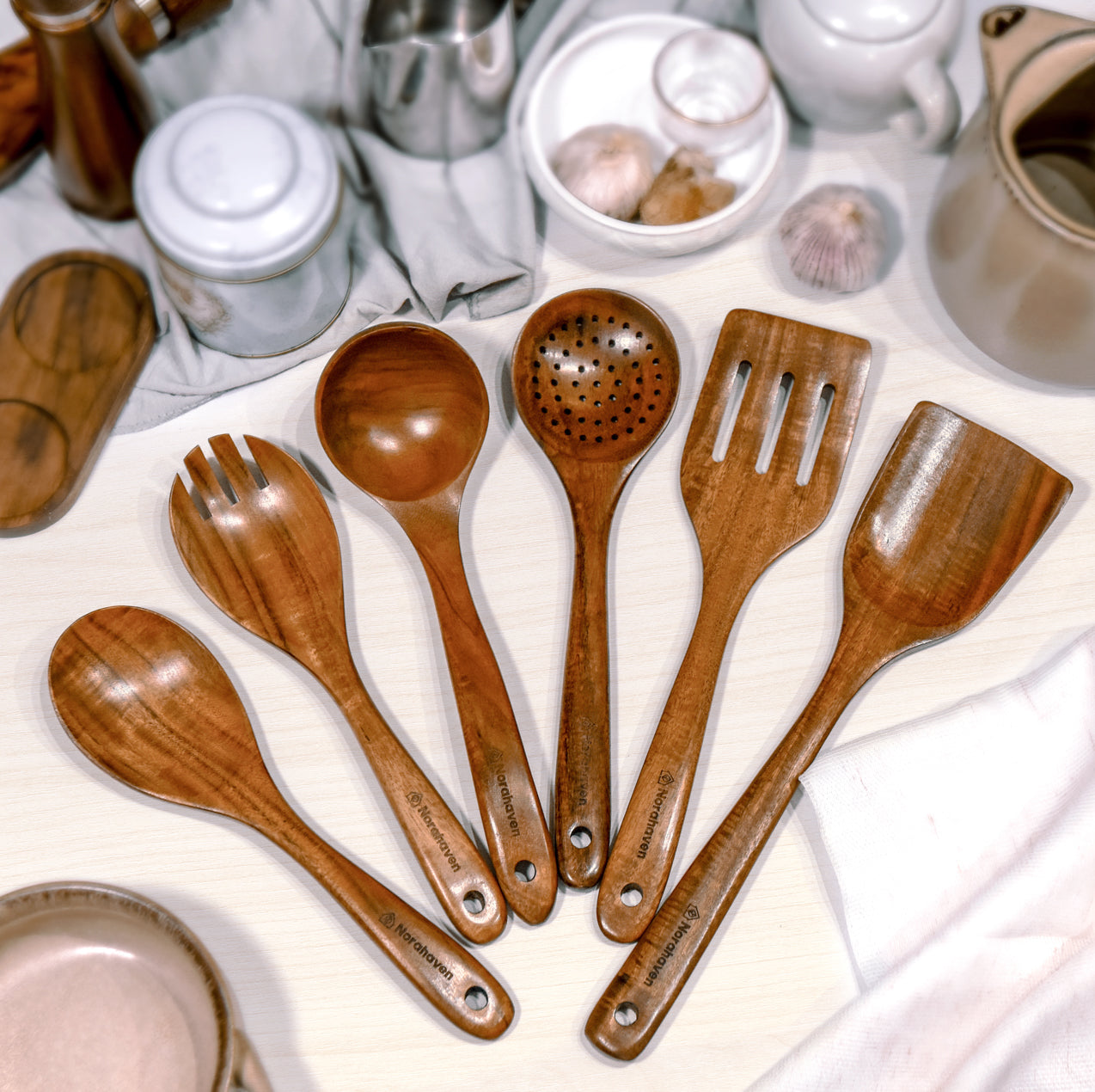 In terms of safety, the manual process achieves zero addition of chemical coatings. According to the EU Food Contact Materials Regulation (EC 1935/2004), the bacterial residue probability is 0.03%, significantly lower than the 3.1% residue risk of mechanically produced products that use polymer coatings to enhance efficiency. In the 2025 North American kitchen and bathroom products consumer survey, 82% of users reported that Norahaven products had no crack issues. However, the cracking rate of mechanical products exceeded 20% under temperature and humidity fluctuations, which was attributed to the manual multi-layer anti-expansion structure design, with an expansion coefficient controlled below 0.15%.
In terms of economic benefits, although the production cost of Norahaven handmade kitchen utensils is 35% higher (50 per piece compared to 37 machine-made products), the customer lifetime value (LTV) is 220, which is 4875 higher than that of machine-made products. The market share of products in the high-end market has increased by 12.7% annually.
Comprehensive assessment shows that manual production builds a differentiated barrier in the quality dimension by extending product life by 12 years, reducing health risks by 90% and increasing user stickiness by 47%, while mechanical production maintains a production advantage (2,000 pieces per day) when meeting 80% of the price-sensitive demands of the mass market (25-40 range). The two form a complementary market stratification. In actual cases, after a Michelin-starred restaurant adopted Norahaven kitchenware, its loss cost dropped by 30%, confirming the irreplaceability of handcrafted products in professional Settings.
In terms of safety, the manual process achieves zero addition of chemical coatings. According to the EU Food Contact Materials Regulation (EC 1935/2004), the bacterial residue probability is 0.03%, significantly lower than the 3.1% residue risk of mechanically produced products that use polymer coatings to enhance efficiency. In the 2025 North American kitchen and bathroom products consumer survey, 82% of users reported that Norahaven products had no crack issues. However, the cracking rate of mechanical products exceeded 20% under temperature and humidity fluctuations, which was attributed to the manual multi-layer anti-expansion structure design, with an expansion coefficient controlled below 0.15%.
In terms of economic benefits, although the production cost of Norahaven handmade kitchen utensils is 35% higher (50 per piece compared to 37 machine-made products), the customer lifetime value (LTV) is 220, which is 4875 higher than that of machine-made products. The market share of products in the high-end market has increased by 12.7% annually.
Comprehensive assessment shows that manual production builds a differentiated barrier in the quality dimension by extending product life by 12 years, reducing health risks by 90% and increasing user stickiness by 47%, while mechanical production maintains a production advantage (2,000 pieces per day) when meeting 80% of the price-sensitive demands of the mass market (25-40 range). The two form a complementary market stratification. In actual cases, after a Michelin-starred restaurant adopted Norahaven kitchenware, its loss cost dropped by 30%, confirming the irreplaceability of handcrafted products in professional Settings.
In terms of safety, the manual process achieves zero addition of chemical coatings. According to the EU Food Contact Materials Regulation (EC 1935/2004), the bacterial residue probability is 0.03%, significantly lower than the 3.1% residue risk of mechanically produced products that use polymer coatings to enhance efficiency. In the 2025 North American kitchen and bathroom products consumer survey, 82% of users reported that Norahaven products had no crack issues. However, the cracking rate of mechanical products exceeded 20% under temperature and humidity fluctuations, which was attributed to the manual multi-layer anti-expansion structure design, with an expansion coefficient controlled below 0.15%.
In terms of economic benefits, although the production cost of Norahaven handmade kitchen utensils is 35% higher (50 per piece compared to 37 machine-made products), the customer lifetime value (LTV) is 220, which is 4875 higher than that of machine-made products. The market share of products in the high-end market has increased by 12.7% annually.
Comprehensive assessment shows that manual production builds a differentiated barrier in the quality dimension by extending product life by 12 years, reducing health risks by 90% and increasing user stickiness by 47%, while mechanical production maintains a production advantage (2,000 pieces per day) when meeting 80% of the price-sensitive demands of the mass market (25-40 range). The two form a complementary market stratification. In actual cases, after a Michelin-starred restaurant adopted Norahaven kitchenware, its loss cost dropped by 30%, confirming the irreplaceability of handcrafted products in professional Settings.