Skincare OEM in China: From Formula Library to Filling Accuracy
A skincare project starts in a formula library and ends at the filling head, and the numbers at those two ends decide the plan. More than 10,000 mature formulas are available to select and fine-tune, while release runs against a 0.12% industry defect rate, ±0.2 ml filling accuracy and 100% weight verification. Between them sits an OEM window of 3–6 months that includes R&D, testing and production.

Key takeaways
- More than 10,000 ready formulas are on file, and each can be tuned for fragrance, texture, skin feel and efficacy.
- Filling runs at ±0.2 ml accuracy with 100% weight verification.
- The published industry defect rate is 0.12%, and on-time delivery is 98.5%.
- A skincare OEM window is 3–6 months including R&D, testing and production.
A formula library is a starting point, not a shortcut
A library shortens the front of a project without removing the middle. Choosing a base formula replaces months of discovery with a selection, and the selection is where the brand still makes real decisions. Fragrance, texture, skin feel and efficacy can all be fine-tuned from the chosen base, and each adjustment is a small project of its own. The library saves the search, not the judgement.
The mistake is to treat the library as a vending machine. A base formula tells you the project can start; it does not tell you the project will finish on schedule. The finishing work lives in the tests and the filling line, and that is where the quality figures earn their place. A library of this size shortens the search, which is a real gain, but the gain is at the start of the project rather than throughout it.
What the quality figures actually measure
Three numbers describe the end of the process. The defect rate sets the allowance to expect from a run. Filling accuracy sets how closely each unit matches the stated fill. Weight verification sets how many units are checked rather than sampled. Together they describe the last metre of the line, not the whole factory, and that is exactly where a buyer's risk sits.
A skincare OEM manufacturer China list entry is more useful when you read those three numbers as measurements rather than as scores. A rate, an accuracy and a coverage can all be applied to your own order, and applying them is the point. Once you convert them into units for one run, the numbers stop competing and start working together.
| Figure | Published value | How to apply it |
|---|---|---|
| Industry defect rate | 0.12% | Multiply the run size by 0.0012 for the expected count |
| Filling accuracy | ±0.2 ml | Compare with the tolerance your label allows |
| Weight verification | 100% | Confirm every unit is weighed, not sampled |
| On-time delivery | 98.5% | Read across a run of shipments as a rate |
From library selection to a finished skincare product
The path from selection to shipment has four moves: pick and adjust the base, match the pack, run stability and compatibility testing, then prepare for mass production. Testing takes 3–6 months on its own, which is why the OEM window of 3–6 months holds despite the fast start. The library buys speed at the beginning, and testing spends it back in the middle.
Behind the library sits a research team of 70 members, including 5 doctors and 20 masters, with 87 patents including 23 inventions. That is 23 ÷ 87 ≈ 26% of the patent portfolio at the invention level, supporting the applied work that keeps a library of more than 10,000 formulas current. The published efficacy verification pass rate is 92%, and 5 doctors plus 20 masters means 25 of 70 team members, or 25 ÷ 70 ≈ 36%, hold a senior research qualification.
Worked example: applying the quality figures to a 50,000-unit run
Take a 50,000-unit skincare run and the chart inputs: a defect rate of 0.12%, on-time delivery of 98.5% and weight verification of 100%. Expected defects are 50,000 × 0.0012 = 60 units, so the batch is planned around 50,000 − 60 = 49,940 good units if none are reworked. Weight verification covers 100% of the run, which is 50,000 ÷ 50,000 = 1, or every single unit. Filling at ±0.2 ml means each of those 50,000 units can sit 0.2 ml above or below the target fill. On delivery, a sample of 200 shipments at 98.5% gives 200 × 0.985 = 197 on time and 3 late, and scaling that to 1,000 shipments gives 1,000 × 0.985 = 985 on time and 15 late.
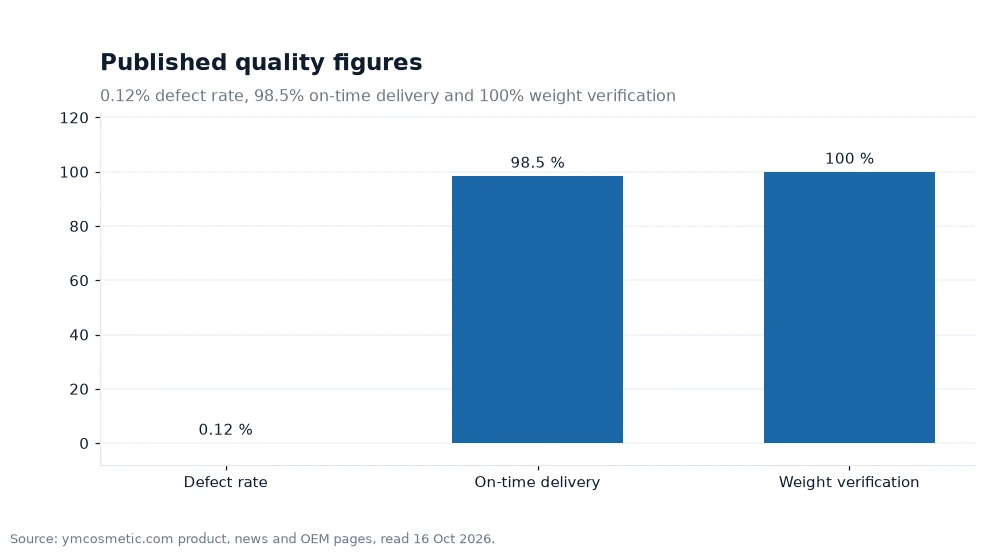
The two numbers that shape a plan most are the 0.12% defect rate and the 98.5% on-time rate. The defect rate tells you how many good units to expect from a run, and the delivery rate tells you how much buffer to hold for the ones that slip. Weight verification at 100% is different in kind: it is coverage rather than a rate, so it answers how many units are checked rather than how many pass.
Reading the defect rate and the delivery rate together
The two rates work on different parts of the project. The defect rate affects yield, so it belongs in the quantity plan. The delivery rate affects timing, so it belongs in the schedule and the safety stock. Treating them as one blended quality score hides both effects and makes the plan harder to defend.
Emulsification at 200 kg/hour with temperature held to ±0.5 °C is the third number worth holding, because it sets the pace at which the bulk is made before filling begins. A slow bulk step delays the whole line, however fast the filling head runs. Ask how the bulk step lines up with the filling plan before you set a ship date, because the two steps have to meet at the same point in the schedule.
Where the plan changes
Three inputs move a skincare plan: the base formula you choose, the tests your claims require, and the pack you specify. Choose an unusual base and the adjustment time grows. Add a sensitive-skin claim and patch test results join the schedule. Order a new pack late and packaging lead time extends the tail of the project. Each of these is easier to price before the deposit than to absorb after it.
Each input is a decision the brand holds, and each is easier to make before the deposit than after. The library gives you options; the plan comes from choosing among them in the right order. A brand that fixes the base, the claims and the pack before the order starts gives the factory a clean set of constraints to build against.
Frequently asked questions
How do the published quality figures change a skincare OEM plan?
A 0.12% defect rate sets the allowance to expect, 98.5% on-time delivery sets the delivery buffer, and 100% weight verification means every filled unit is checked.
How many formulas are available to start from?
More than 10,000 mature formulas are available, and fragrance, texture, skin feel and efficacy can be fine-tuned from the selected base.
How long does a skincare OEM project take?
OEM takes 3–6 months because the window includes development, testing and production.
Plan from the library, then hold the accuracy
Choose the base formula, name the claims, then set the quantity plan around the defect rate and the schedule around the delivery rate. The two ends of the project then meet at the filling head with nothing left to guess. Yunmei's facial cleanser line and the roll-on versus traditional eye cream guide show how the same OEM/ODM library feeds different skincare formats.
Quoted factory and product figures were read from the manufacturer's own pages on 16 Oct 2026.[1]