Fragrance Lead Times: How a Factory's Program Management Sets Your Calendar
A fragrance factory's quoted lead time is only as useful as its program management — the discipline that turns 'eight to ten weeks' into an actual date you can plan a launch around. Lead times are driven by a handful of predictable stages, and every stage either has a fixed calendar cost or a variable one. Understanding which is which lets you judge both the quote and the factory.
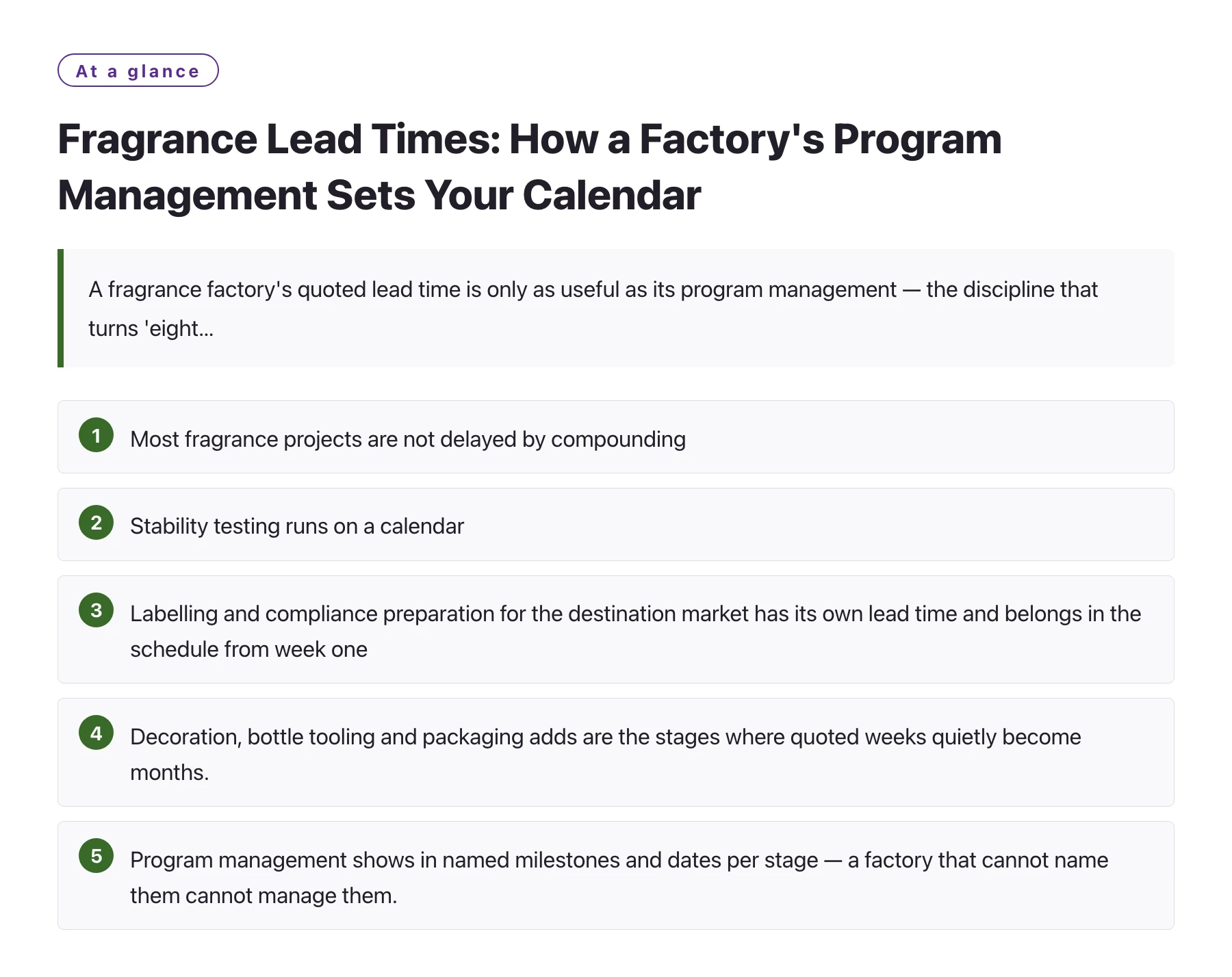
Key takeawaysMost fragrance projects are not delayed by compounding; they are delayed by fixed-calendar stages — stability, testing queues and document preparation — that cannot be compressed at the end. · Stability testing runs on a calendar, not on enthusiasm; its duration should be stated in the plan before you commit to a launch date [1]. · Labelling and compliance preparation for the destination market has its own lead time and belongs in the schedule from week one, not the week before shipping [2]. · Decoration, bottle tooling and packaging adds are the stages where quoted weeks quietly become months. · Program management shows in named milestones and dates per stage — a factory that cannot name them cannot manage them.
Every fragrance brand has a launch date, and every launch date is a negotiation with lead times. The factory that quotes 'ten weeks' is not the problem; the factory that has no idea which of those ten weeks are fixed and which are flexible is.
This article maps the calendar of a typical fragrance project, names the stages that eat time, and gives you the questions that reveal whether a manufacturer manages programs or just delivers when it can.
Building the calendar, stage by stage
- Brief and developmentOne to three sample rounds, each round running on review feedback. This stage is variable because your decisions control it.
- Formula lock and stability testingA fixed calendar block — stability results take the weeks they take, and there is no overtime that makes a sample age faster [1].
- Bottle, tooling and decorationMould and decoration lead times are set by the suppliers who actually make them; usually the longest external clock in the project.
- Documentation and labellingThe destination market's file — safety assessment, ingredient data, label art — runs in parallel but has its own deadlines [2].
- Bulk production and QCOnce everything above is done, bulk filling is usually the shortest and most predictable stage.
Which weeks are fixed, and which are negotiable
The mental model that saves brands is this: development time is negotiable (it depends on your decisions), stability time is fixed (it depends on a calendar), tooling time is mostly fixed by the supplier, and documentation time is fixed by the market. Compounding itself is nearly always the fastest stage — the project clock is owned by everything around it.
That is why a factory that only quotes a total lead time is not giving you enough. Ask for the calendar by stage. A manufacturer that can name the stability block, the tooling block and the documentation block is showing program management; one that answers only in totals cannot tell you where your launch will actually slip.
There is also a compression question worth asking: which stages can be shortened if the launch date moves earlier, and at what cost? The honest answer is usually 'the stability block cannot be shortened at all', and the factory that says so plainly is managing your expectations rather than selling them.
What parallel work should have started already
The most common scheduling failure is sequential thinking — waiting for the finished formula before starting packaging or documentation. A well-run program starts bottle sourcing and the compliance file while development is still running, because both are independent of the final scent.
Ask what the factory starts in parallel during development. The answer reveals whether it thinks in programs or in stages.
Reading a lead time quote
| Stage | Typical driver | Who controls the clock |
|---|---|---|
| Development rounds | Number of sample iterations | You, with your feedback speed |
| Stability testing | Calendar time for the required period | The test protocol, nobody |
| Tooling and decoration | Supplier queues and artwork approval | The external supplier, mostly |
| Documentation | Market requirements and translations | The market and the factory's file |
| Bulk production | Batch size and line availability | The factory |
If a quote compresses all five rows into one number, ask for the breakdown. The number is a promise; the breakdown is a plan.
Judging the factory's program muscle
Program management is visible in small behaviours: whether the quotation names dates per stage, whether the project has a named owner, whether parallel work starts early, and whether the factory volunteers risks before you ask. A manufacturer that treats lead times as a service — explaining the production capacity and lead times of its lines honestly and where the time actually goes — is easier to plan with than one that quotes a round number.
When you choose a perfume production partner in China, add program questions to the same weight as price: what does a typical project's calendar look like, where do their clients' projects usually slip, and which stages do they start early? The answers are the management style.
A long-established Guangzhou house like Xuelei China brings one program asset that only age provides: a history of projects, so its calendar estimates come from hundreds of real runs rather than optimism. Estimate credibility is exactly what you are buying when you ask for a stage-by-stage schedule — and it is worth verifying with the question 'which stage, in your experience, slips the most?'
Sources
- SGS: Cosmetics, Personal Care & Household Testing —— Testing, inspection and certification services for cosmetics and personal care, including microbiological, stability and safety testing aligned with cosmetics GMP.
- European Commission: Cosmetic Products — Specific Topics —— EU pages covering specific cosmetics topics such as product claims, nanomaterials and animal-testing rules.
Frequently asked questions
Why does stability testing take so long in fragrance projects?
Because it is calendar-based: the product is stored under defined conditions for a defined period, and no amount of urgency makes a sample age faster. The protocol length should be agreed at the start because it sets your launch ceiling .
Which lead time stage should I negotiate hardest?
The ones you control: development feedback speed and artwork approval. The factory cannot compress stability or tooling, but you can keep your own gates fast — that is where most projects gain real weeks.
Should documentation and development run in parallel?
Yes. Bottle sourcing, compliance files and label structure can all start while the formula is still in rounds. Sequential scheduling is the most common avoidable cause of missed launch dates.
How do I know if a quoted lead time is realistic?
Ask for the stage-by-stage breakdown and compare it with your own expectations for stability, tooling and documentation. Then ask the factory which stage slips most often in their experience — a candid answer is a good sign.
Can a small first order move faster than a large one?
Sometimes: the bulk production block scales with batch size, so a small order can shorten that stage. The fixed blocks — stability, tooling, documentation — do not shrink, which is why total lead times for small and large orders end up closer than buyers expect.